
- 50%
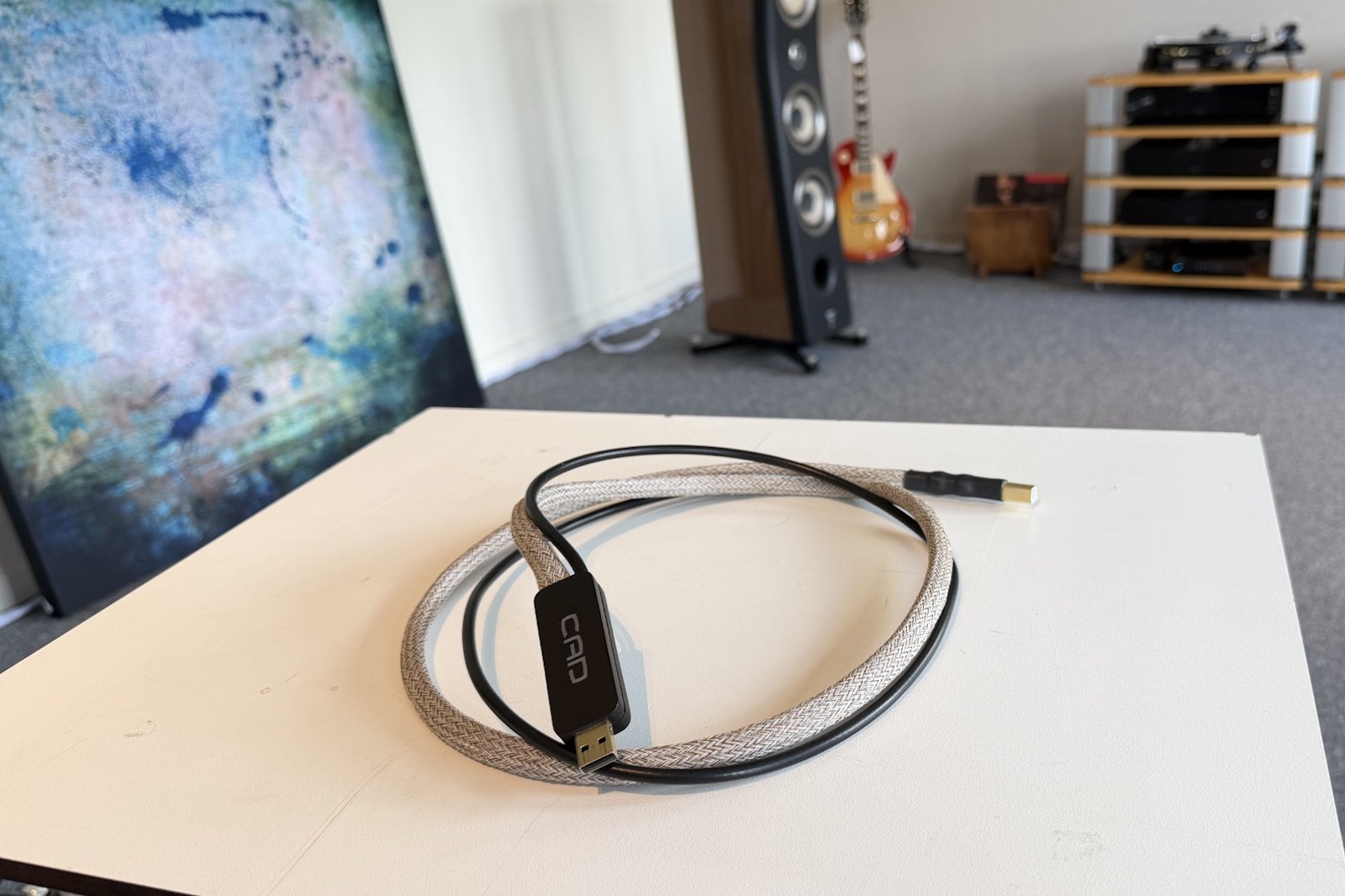
CAD USB II-R Cable - Begagnad USB kabel
19 000 SEK9 500 SEK
Lägsta pris de senaste 30 dagarna19 000 SEK- Betala säkert med kort
- Maila oss, vi svarar snabbt!
Beskrivning
Art.nr: 4386
Kritikerhyllad USB kabel från CAD.
The USB interface inside your DAC has two high frequency oscillators running in the MHz range. These are made from a crystal material that is tuned to vibrate at an extremely accurate frequency when a voltage is applied. So, if you connect a USB cable that is vibrating (even very small amounts) this will have an effect on the oscillators on the USB interface inside your DAC. One of the designs of the USB II-R cable is to minimize vibration from your server reaching your DAC.
Compared to purely analogue devices (e.g. turntables), digital audio source components produce more high frequency “noise” (EMI/RFI). This is generated within CPUs, chipsets, switch mode power supplies and regulators and so on. Also the basic USB carrier frequency can be in the 200 MHz to 400MHz frequency range. Digital audio interconnects have a range of issues that are significantly different from analogue audio interconnects. During listening tests we found that when we reduced the amount of this “noise” from reaching the Digital to Analogue Converter (DAC), sound quality dramatically improved in our opinion.
Secondly, it is now widely accepted that the materials and construction of analogue cables can influence the quality of sound that a system produces, and our thesis (which again, is now more widely accepted) is that digital cabling has at least the same impact.
Noise reduction
CAD USB II-R Cable features our patented USB filter, which filters noise from the music source (whether a computer or audio server or streamer).
The USB consists of 4 connections:
1) +5V : Only used for powering devices – many DACs use this power source, but not all.
2) DATA+ : Differential signal, very high speed
3) DATA- : Differential signal, very high speed
4) Ground : Reference
Unwanted noise is present on all 4 connections. Our patented filter reduces the noise on the differential signal. +5V and Ground without damaging the signal or power delivery itself.
The +5V line contains exceptionally large amounts of high frequency noise. To minimize the amount of this noise from entering the DATA and Ground connections, the CAD Cable uses a separate highly shielded cable for the +5V line.
Wire materials and construction
CAD sees “Digital Signals” as very high speed analogue square waves. Conductors used for high speed signals use different materials and construction techniques compared to conductors that only operate at lower frequencies. As explained above there are 4 conductors in a USB cable. The requirements for the DATA+ and DATA- conductors are completely different from those for the Ground and +5V conductors.
When we compared conductors made with different materials and/or construction techniques we also noted sound quality differences. We have meticulously researched the best materials and construction techniques for the conductors inside our CAD cable. Our main measurement tool is subjective listening tests, but over time we learned what parameters are technically important.
Filer och media
 | Editors choice i The Ear |
| Test i Hifi+ |
| Info hos tillverkaren |
